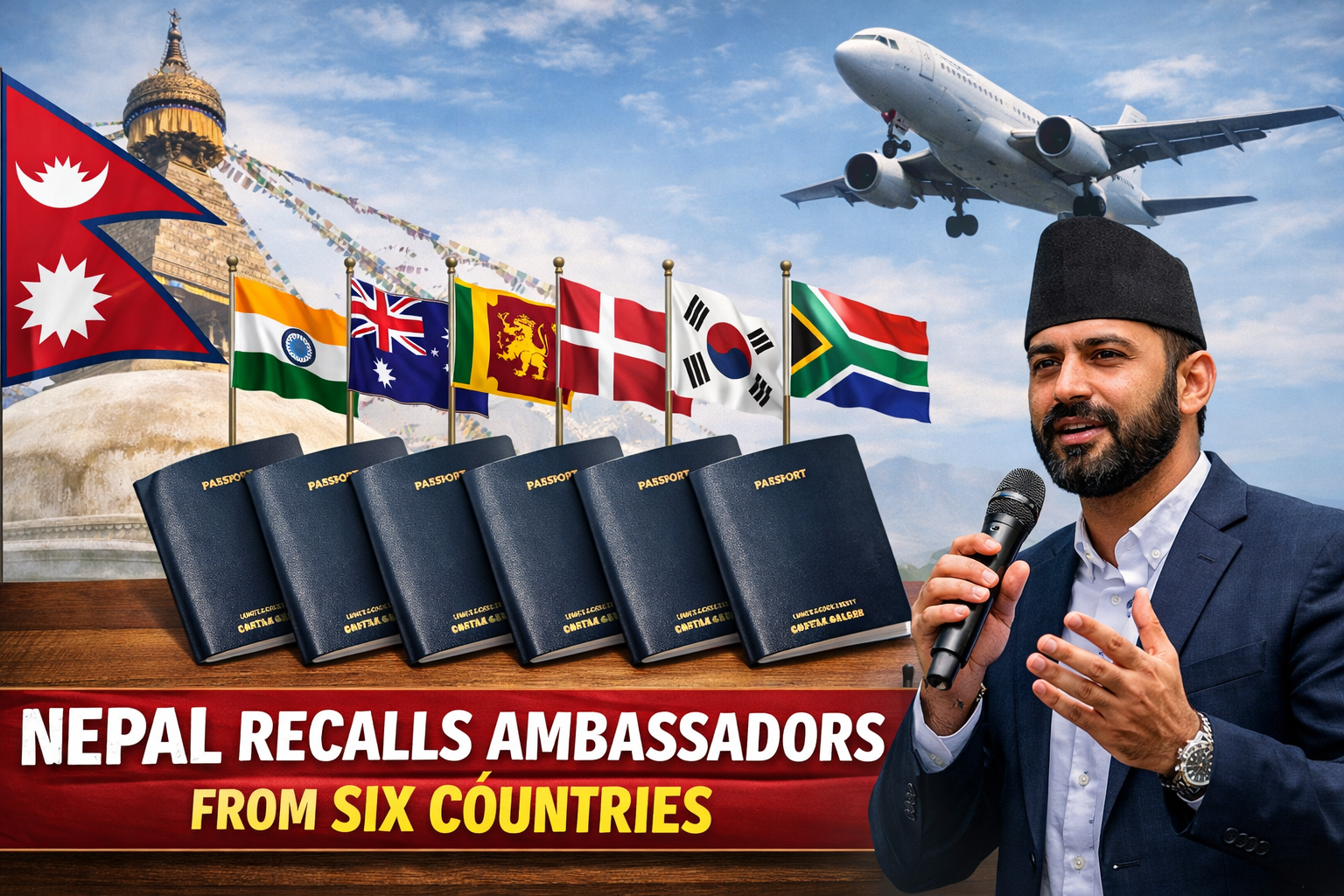
Nepal’s newly formed government has made a major move by recalling its ambassadors from six countries, including India, and has given them one month to return.
Nepal’s New Government Recalls Ambassadors from Six Countries, Signals Major Foreign Policy Reset
In a significant diplomatic move, the newly formed government of Nepal has decided to recall its ambassadors from six countries, including India and Australia. The decision, taken by the cabinet led by Prime Minister Balendra Shah, marks one of the first major foreign policy actions of the new administration and reflects a broader effort to restructure diplomatic appointments made under the previous government of KP Sharma Oli.
According to Nepal’s Ministry of Foreign Affairs, the ambassadors have been given a one-month deadline to return to Kathmandu. The move has triggered political debate, raised questions about continuity in foreign policy, and drawn attention from international observers, especially in countries directly affected by the recall.
Background: Political Transition in Nepal
Nepal has recently undergone a major political shift following widespread public dissatisfaction and a strong youth-driven movement that led to the fall of the Oli-led government. The rise of Balendra Shah—often referred to as “Balen Shah,” a rapper-turned-politician—symbolizes a new wave of leadership that promises reform, transparency, and institutional restructuring.
Shah’s ascent to power represents a break from traditional political elites. His government has emphasized accountability and has begun reviewing key decisions taken by the previous administration. Among these, diplomatic appointments have emerged as a critical area of focus.
Ambassadors in Nepal are often appointed through political considerations, a practice that has been criticized for undermining professionalism in foreign service. The Oli government had appointed several ambassadors under what critics describe as a “political quota system,” which the new administration now appears intent on revisiting.
The Decision: Ambassadors Recalled
The cabinet decision to recall ambassadors was confirmed by Foreign Ministry spokesperson Lok Bahadur Chhetri, who stated that formal letters have already been issued. The six countries from which ambassadors have been recalled include:
India
Australia
Sri Lanka
Denmark
South Korea
South Africa
Among those affected is Nepal’s Ambassador to India, Shankar Prasad Sharma, along with Chitralekha Yadav (Australia), Sumnima Tuladhar (Denmark), Purna Bahadur Nepali (Sri Lanka), Shivamaya Tumbahamphe (South Korea), and Kapil Man Shrestha (South Africa).
These diplomats have been instructed to return within a month, indicating a swift and decisive approach by the Shah government.
Why Were the Ambassadors Recalled?
The primary reason cited for the recall is that these ambassadors were appointed during the tenure of the previous Oli government. The Shah administration is reportedly aiming to replace them with individuals aligned with its own policy priorities and governance philosophy.
This move is not unprecedented in Nepal’s political landscape. Previous governments have also recalled ambassadors appointed by their predecessors. For instance, an earlier caretaker government had withdrawn 11 out of 17 politically appointed ambassadors.
However, the scale and timing of the current decision highlight the urgency with which the Shah government is pursuing its reform agenda.
Implications for Nepal’s Foreign Policy
The recall of ambassadors from key countries carries significant implications for Nepal’s foreign relations.
1. Relations with India
India is one of Nepal’s most important neighbors, sharing deep historical, cultural, and economic ties. Any change in diplomatic representation in New Delhi is closely watched.
The recall of Nepal’s ambassador to India could signal a recalibration of bilateral relations. While there is no indication of immediate tension, the move may temporarily slow diplomatic engagements until a new envoy is appointed.
Experts suggest that the Shah government may seek to redefine Nepal’s approach toward India, possibly emphasizing greater balance and independence in foreign policy.
2. Engagement with Global Partners
Countries like Australia, South Korea, and Denmark are important partners in areas such as education, labor migration, development aid, and trade.
Recalling ambassadors from these nations could create short-term disruptions in diplomatic communication. However, it also opens the door for new appointments that align more closely with the current government’s priorities.
3. Institutional Reform
The decision underscores a broader effort to professionalize Nepal’s diplomatic service. By replacing politically appointed ambassadors, the government may aim to prioritize merit-based appointments in the future.
If implemented effectively, this could strengthen Nepal’s international standing and improve the efficiency of its foreign missions.
Domestic Political Reactions
The move has sparked mixed reactions within Nepal.
Supporters of the Shah government view the decision as a necessary step toward cleaning up political appointments and ensuring accountability. They argue that ambassadors should represent national interests rather than political affiliations.
Critics, however, have raised concerns about the potential politicization of diplomacy. They warn that frequent changes in ambassadors can disrupt continuity and weaken long-term relationships with foreign partners.
Opposition leaders associated with the Oli camp have accused the government of engaging in political vendetta. They argue that the recall undermines experienced diplomats who were already serving in important roles.
Public Sentiment and Youth Influence
The recall decision must also be understood in the context of Nepal’s evolving political culture. The rise of Balendra Shah was fueled by strong public demand for change, particularly among young voters.
Many citizens see this move as a fulfillment of campaign promises to dismantle entrenched political networks and introduce transparency in governance.
Social media reactions have largely been supportive, with many users praising the government for taking bold steps. However, some have urged caution, emphasizing the need for careful selection of new ambassadors to avoid repeating past mistakes.
Challenges Ahead
While the recall of ambassadors is a bold move, it also presents several challenges for the Shah government:
1. Appointment of New Ambassadors
Selecting qualified and experienced diplomats will be crucial. Any perception of favoritism or lack of merit could undermine the government’s reform agenda.
2. Maintaining Diplomatic Continuity
Transitions in diplomatic leadership can lead to temporary gaps in communication. The government will need to ensure that these transitions are smooth and do not affect ongoing bilateral or multilateral engagements.
3. Managing International Perception
Frequent changes in diplomatic representation may raise concerns among foreign partners about policy stability. The government must clearly communicate its intentions to maintain confidence.
A Broader Pattern in Nepal’s Politics
The recall of ambassadors reflects a recurring pattern in Nepal’s political system, where changes in government often lead to widespread reshuffling of appointments.
This practice has been criticized for prioritizing political loyalty over institutional continuity. However, it also highlights the dynamic nature of Nepal’s democracy, where new governments seek to assert their authority and implement their vision.
The challenge lies in striking a balance between political change and institutional stability.
What Lies Ahead?
As Nepal moves forward under the leadership of Balendra Shah, the recall of ambassadors is likely just the beginning of a broader transformation.
The government is expected to:
Appoint new ambassadors aligned with its foreign policy goals
Review other political appointments made by the previous administration
Introduce reforms aimed at strengthening governance and transparency
International observers will be closely watching how these changes unfold, particularly in terms of their impact on Nepal’s diplomatic relations and global image.
Conclusion
The decision by Nepal’s new government to recall ambassadors from six countries marks a significant moment in the country’s political and diplomatic landscape. It reflects a clear intent to break from past practices and establish a new approach to governance and foreign policy.
While the move has generated both support and criticism, it underscores the broader transformation underway in Nepal. As the Shah government navigates the challenges ahead, its ability to balance reform with stability will be key to shaping the country’s future on the global stage.
In the coming months, the focus will shift to who replaces these ambassadors and how effectively the new administration manages its international relationships. For now, the recall decision stands as a bold statement of change—one that could redefine Nepal’s diplomatic trajectory in the years to come.