Bayer’s US chief says tariffs won’t impact its 2026 outlook
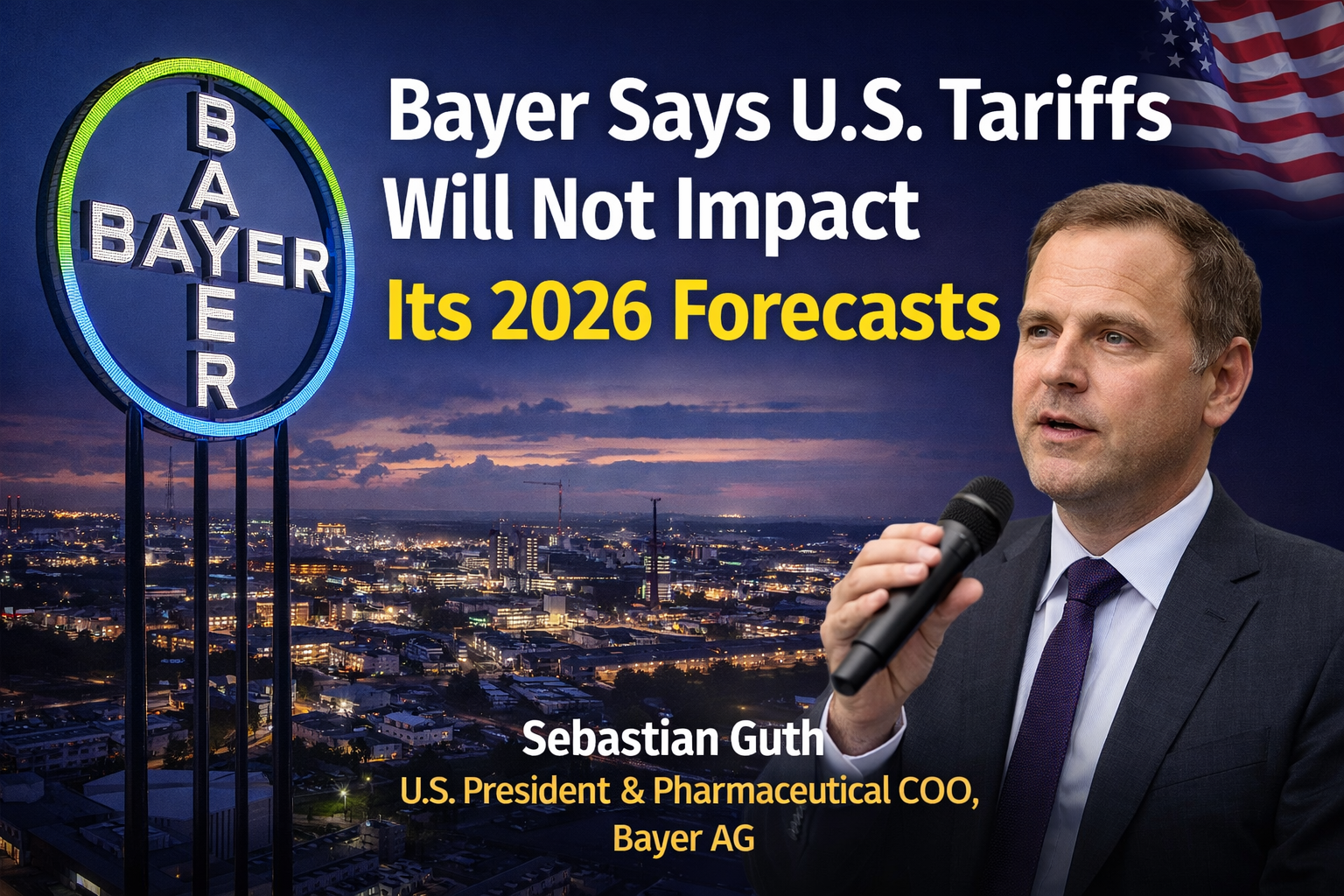
Bayer Says U.S. Tariffs Will Not Impact Its 2026 Forecasts, Signals Confidence in Global Strategy
4
In a significant development for the global pharmaceutical industry, Bayer AG has stated that recently announced U.S. tariffs on imported medicines will not affect its financial outlook for 2026. The reassurance comes amid growing concerns across the healthcare sector following new trade measures introduced by the administration of Donald Trump.
Speaking to Reuters, Bayer’s Pharmaceuticals Chief Operating Officer and U.S. President Sebastian Guth said the company had already factored potential tariff impacts into its forecasts, signaling strong confidence in its planning and global business strategy.
Tariffs and the Pharmaceutical Industry: A New Challenge
The U.S. government’s decision to impose tariffs on imported branded pharmaceuticals marks a notable shift in trade policy. The move is part of a broader effort to encourage domestic manufacturing and reduce reliance on foreign supply chains.
Under the new policy framework:
Tariffs will apply to imported branded medicines
Companies can avoid tariffs by agreeing to government pricing deals
Alternatively, firms may commit to manufacturing drugs within the United States
These tariffs are expected to take effect starting September 2026, giving companies a limited window to adjust their strategies.
The announcement has raised concerns across the pharmaceutical sector, particularly among European companies that export significant volumes of medicines to the U.S. market.
Bayer’s Response: Confidence in Preparedness
Despite these developments, Bayer remains unfazed. According to Sebastian Guth, the company had already anticipated potential tariff scenarios while preparing its 2026 financial guidance.
“We feel that we've appropriately anticipated tariffs as we think about our 2026 guidance,” Guth said.
This statement highlights Bayer’s proactive approach to risk management. By incorporating possible trade disruptions into its forecasts, the company has insulated itself from sudden policy changes.
Bayer’s confidence is further reinforced by its diversified global operations, which span pharmaceuticals, consumer health products, and crop science.
Financial Outlook for 2026
Earlier this year, Bayer projected its EBITDA (earnings before interest, taxes, depreciation, and amortization) before special items to be in the range of:
€9.6 billion to €10.1 billion for 2026
This compares closely with its 2025 EBITDA of approximately €9.669 billion, indicating stable growth expectations despite external uncertainties.
The decision not to revise these figures suggests that Bayer believes the tariff impact will be manageable and will not significantly alter its revenue or cost structure.
Role of the EU-U.S. Trade Agreement
One of the key reasons behind Bayer’s confidence is the existing trade agreement between the European Union and the United States.
Under this agreement:
Tariffs on most goods, including medicines, are capped at 15%
The U.S. has committed to honoring this arrangement
This cap provides a degree of predictability for European pharmaceutical companies like Bayer. It ensures that even if tariffs are applied, they will remain within manageable limits.
Guth emphasized that this agreement plays a crucial role in stabilizing expectations and reducing uncertainty.
Exclusion from Initial Tariff Exemptions
Interestingly, Bayer was not among the 16 major pharmaceutical companies that initially secured exemptions from the new tariffs.
These exemptions were granted to companies that entered into agreements with the U.S. government, potentially involving:
Price controls on medicines
Commitments to domestic production
While Bayer has not confirmed whether it is in discussions with U.S. authorities, Guth declined to comment on any ongoing negotiations.
This leaves open the possibility that Bayer could still seek exemptions or adapt its strategy depending on how the policy evolves.
Global Trade Dynamics: The UK-U.S. Deal
Another important development shaping the pharmaceutical landscape is the recent trade agreement between the United States and the United Kingdom.
Key features of the deal include:
Tariff-free access for UK-made medicines entering the U.S.
In return, the UK has agreed to increase spending on medicines
The UK government has committed to raising pharmaceutical expenditure:
From 0.3% of GDP to 0.35% by 2028
Further to 0.6% by 2035
Guth described this agreement as a potential “blueprint” for other wealthy nations. It suggests a model where countries can secure favorable trade terms by adjusting domestic pricing and spending policies.
Implications for the Global Pharmaceutical Industry
The introduction of tariffs and new trade agreements signals a broader transformation in the global pharmaceutical sector.
1. Shift Toward Domestic Manufacturing
Governments, particularly in the U.S., are increasingly prioritizing local production of medicines. This could lead to:
Expansion of manufacturing facilities within the U.S.
Reduced dependence on imports
Higher operational costs for companies relocating production
2. Pricing Pressures
To avoid tariffs, companies may need to agree to lower drug prices, impacting profit margins.
3. Strategic Realignments
Pharmaceutical firms may need to rethink supply chains, investment strategies, and market priorities.
Bayer’s Strategic Position
Bayer’s ability to maintain its 2026 forecast reflects its strong strategic positioning.
Diversified Portfolio
Unlike companies focused solely on pharmaceuticals, Bayer operates across multiple sectors:
Pharmaceuticals
Consumer health
Crop science
This diversification helps mitigate risks associated with any single market or policy change.
Global Footprint
With operations in multiple countries, Bayer can adjust its supply chain and production strategy as needed.
Long-Term Planning
By anticipating policy changes, Bayer has demonstrated robust financial planning and risk assessment capabilities.
Market Reaction and Investor Sentiment
The company’s statement is likely to reassure investors who were concerned about the potential impact of tariffs.
Stable forecasts indicate:
Confidence in revenue growth
Effective cost management
Resilience against external shocks
This could help maintain investor trust and support Bayer’s stock performance in the coming months.
Challenges Ahead
Despite its confidence, Bayer still faces several challenges:
1. Policy Uncertainty
Trade policies can change rapidly, especially in politically sensitive sectors like healthcare.
2. Competitive Pressure
Other companies securing tariff exemptions may gain a competitive advantage.
3. Regulatory Environment
Increasing regulation and pricing pressures could impact profitability.
Broader Economic Context
The tariff announcement comes at a time when global trade is undergoing significant changes. Governments are balancing:
Economic nationalism
Supply chain resilience
Public health priorities
The pharmaceutical sector, being critical to national security and public welfare, is at the center of these shifts.
What Lies Ahead
Looking forward, several scenarios could unfold:
More companies may negotiate tariff exemptions
Additional trade agreements could emerge
Pharmaceutical firms may increase investments in U.S.-based manufacturing
For Bayer, the focus will likely remain on maintaining stability while adapting to evolving market conditions.
Conclusion
The statement by Bayer AG that U.S. tariffs will not affect its 2026 forecasts underscores the company’s confidence in its strategic planning and global operations.
While the new trade measures introduced under Donald Trump have created uncertainty across the pharmaceutical industry, Bayer’s preparedness and reliance on existing trade agreements—particularly with the European Union—have helped it navigate these challenges.
As global trade dynamics continue to evolve, Bayer’s approach may serve as a model for other companies seeking to balance risk and opportunity in an increasingly complex environment.
The coming months will be crucial in determining how the industry adapts, but for now, Bayer’s message is clear: despite tariffs and policy shifts, its outlook for 2026 remains steady and unchanged.
Tags:
Related Posts

Nepal’s newly formed government has made a major move by recalling its ambassadors from six countries, including India, and has given them one month to return.

RRB NTPC Graduate Level CBT-I Answer Key 2026