The effects of the Iran war have reached the nation’s kitchens
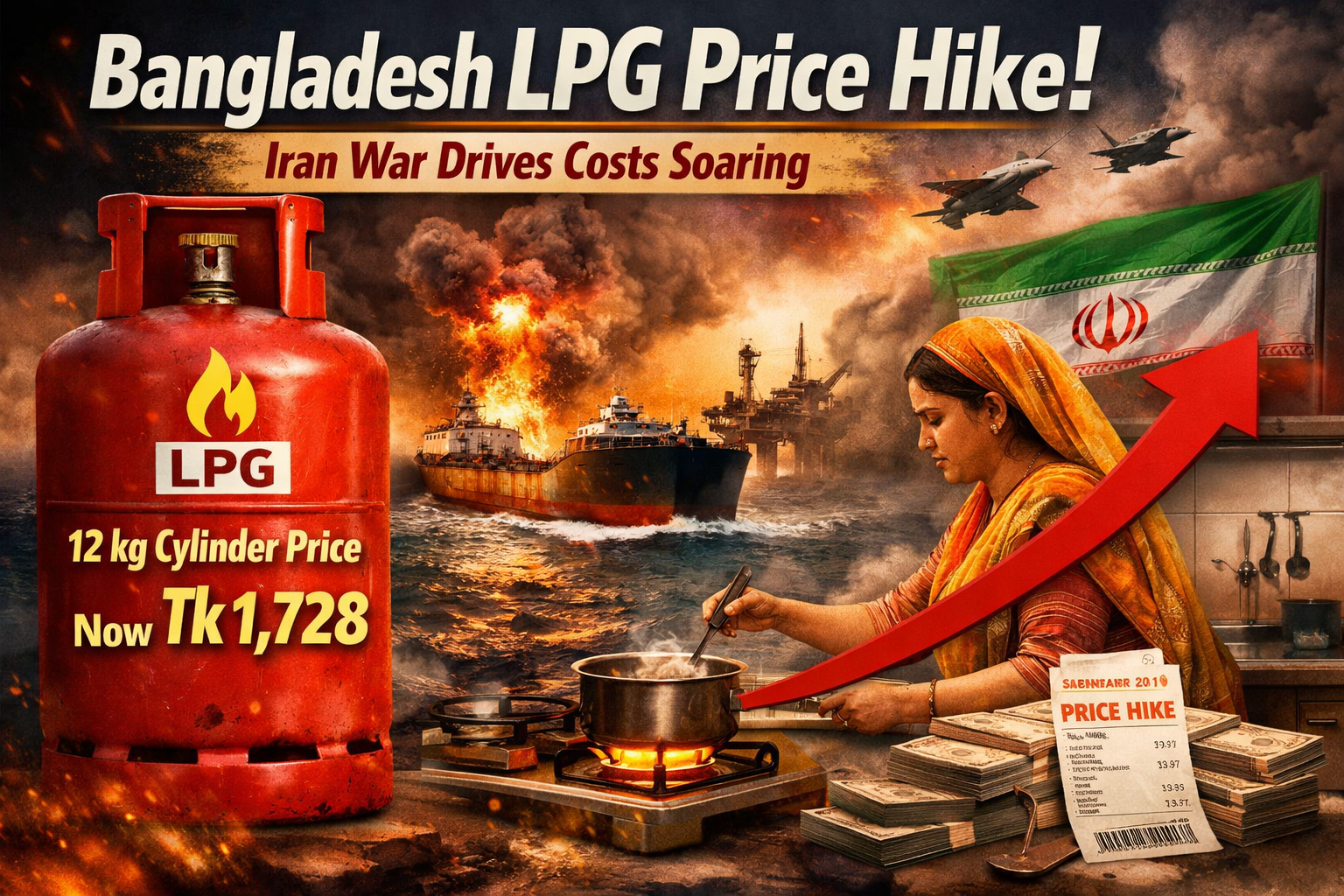
Iran War Drives Sharp LPG Price Hike in Bangladesh, Putting Pressure on Household Budgets
A steep increase in liquefied petroleum gas prices in Bangladesh is bringing the effects of Middle East conflict into ordinary homes, as regulators, importers and retailers clash over what a fair market price should be.
The economic shockwaves of the Iran war are now reaching the kitchens of ordinary Bangladeshis. In a move that is expected to affect millions of households, the Bangladesh Energy Regulatory Commission (BERC) on Thursday raised the price of liquefied petroleum gas (LPG) cylinders by nearly 29 percent, citing a sharp rise in international prices and escalating import-related costs.
The decision marks one of the largest single-month increases in LPG prices since the regulator began fixing rates in April 2021. It also highlights how a geopolitical crisis thousands of miles away can quickly translate into higher living costs for consumers in a country heavily dependent on fuel imports.
Under the new pricing structure, the cost of the widely used 12-kilogram LPG cylinder has been set at Tk 1,728, up by Tk 387 from the previous rate. The revised price is likely to weigh heavily on low- and middle-income households, many of whom rely on LPG as their primary cooking fuel.
For families already struggling with inflation and rising costs of essentials, the latest hike is more than a market adjustment. It is a direct blow to monthly household budgets, one that will be felt in daily meals, routine expenses and purchasing decisions.
Global turmoil, local pain
The latest increase comes against the backdrop of deepening instability in the Middle East. According to regulators and industry insiders, the war involving Iran has pushed up LPG prices in the global market, while also raising shipping costs and other charges linked to fuel transportation.
The average international price of LPG raw materials reportedly climbed by around 45 percent within a month, an extraordinary jump by recent standards. Market observers describe the increase as highly unusual and say it reflects the kind of volatility that often follows geopolitical conflict in major energy-producing regions.
Bangladesh, which imports most of its LPG requirements, has little room to shield itself from such global price shocks. As international benchmark rates rise, local suppliers face higher costs, and those costs eventually flow down the supply chain to consumers.
That is exactly what is happening now.
BERC has revised the LPG retail rate to Tk 144 per kilogram. As a result, the price of smaller and larger cylinders has also gone up. A 5.5-kg cylinder will now cost Tk 792, while the price of a 45-kg cylinder has been fixed at Tk 6,482. In other words, the increase will affect not only households but also small businesses, restaurants and commercial users that depend on LPG for regular operations.
Autogas, the LPG used in motor vehicles, has also become more expensive. The regulator has fixed the new autogas price at Tk 79.77 per litre, compared with Tk 61.83 per litre last month. That jump could eventually have secondary effects, including higher transport-related costs.
One of the biggest monthly hikes in years
The latest revision stands out not only because of its scale but also because of the speed with which prices have moved. Since BERC started setting LPG prices in April 2021, there have been many adjustments based on movements in the global market. But a Tk 387 increase in the price of a 12-kg cylinder in a single month ranks among the steepest month-on-month hikes during this period.
For consumers, that scale matters. LPG is often bought in full-cylinder units rather than in smaller daily quantities, meaning families must absorb the entire increase at once. A sudden rise of nearly Tk 400 can therefore create an immediate cash-flow problem, especially for lower-income users who do not have access to pipeline gas.
The development is also likely to renew debate over whether Bangladesh’s LPG pricing and monitoring system is capable of protecting consumers during periods of severe international market instability.
Official price versus market reality
Although BERC announces a monthly price, consumers have long complained that the amount they actually pay in the retail market is often much higher than the official rate. That gap appears to have widened sharply in recent months.
In March, the regulator had fixed the price of a 12-kg cylinder at Tk 1,341. Yet throughout that month, many ordinary buyers reportedly paid between Tk 1,600 and Tk 1,800 for the same cylinder. By the end of March, prices had risen even further in some places.
Reports suggest that even before Thursday’s official revision, some traders were already selling a 12-kg cylinder for Tk 1,900 to Tk 2,100. In effect, the market had moved far ahead of the regulated rate, reflecting both supply pressure and expectations of further increases.
This pattern has raised difficult questions. If consumers are consistently paying above the official rate, then the regulator’s pricing formula may not be enough on its own to ensure affordability. At the same time, businesses argue that the regulator’s numbers do not always capture the true cost of imports and distribution.
That tension between regulatory intent and market reality lies at the heart of the current crisis.
Businesses challenge the pricing formula
According to officials, companies in the LPG sector submitted a formal note of dissent during a stakeholder meeting held before the latest price announcement. Their position was clear: even the revised price structure did not fully reflect what they are currently paying in the market.
Industry representatives said that some of the cost assumptions used to calculate April’s LPG price were too low, especially in relation to freight and shipment charges. They argued that importers had been paying significantly higher freight rates since the beginning of March and that the regulator’s cost model failed to capture those expenses properly.
This disagreement is not merely technical. It goes to the core of how fuel prices are set in Bangladesh and who bears the burden when global shocks hit the market. If the regulator keeps prices below actual import cost, companies say they face unsustainable losses. If prices fully reflect international turbulence, consumers bear the pain.
For now, both sides appear to agree on one point: the market is under severe strain.
BERC points to supply disruptions and public benchmarks
BERC Chairman Jalal Ahmed acknowledged that the LPG market experienced supply disruptions throughout March. According to him, those disruptions affected the overall market environment and contributed to the abnormal price situation seen in recent weeks.
He said the commission uses several major indicators when determining LPG prices. These include the Saudi Contract Price (CP), exchange rate movements and other related expenses associated with imports. The Saudi CP is a widely followed international reference price and is considered a key benchmark for LPG pricing in many markets across Asia.
Ahmed pointed out that this benchmark is publicly available, meaning importers know in advance when global prices are moving upward. In his view, companies generally have enough information to anticipate price changes and often start adjusting their market behavior before the official domestic revision takes effect.
At the same time, he insisted that compliance with BERC-set prices is mandatory. He said the commission would ask the government to involve district administrations to strengthen market oversight and improve enforcement.
That statement reflects a persistent regulatory concern: even when prices are officially fixed, retailers in many areas continue to charge more. For consumers, enforcement at the local level remains one of the biggest challenges in the LPG market.
Heavy import dependence leaves Bangladesh exposed
Bangladesh’s vulnerability to this kind of shock is rooted in its import dependence. The country relies overwhelmingly on imported LPG to meet domestic demand. Monthly consumption generally ranges from 120,000 to 150,000 tonnes, making a stable import pipeline essential for both household and commercial use.
According to data from the National Board of Revenue (NBR), private importers have managed to bring in around 186,000 tonnes of LPG for April supply. On the surface, that figure suggests that overall availability should be sufficient to meet demand.
But availability on paper does not always guarantee stability in the market. Distribution bottlenecks, uneven regional supply, high transport costs and pricing disputes can all create local shortages or push up retail prices.
Sector insiders also note that Bangladesh’s LPG market has already been facing problems for months. The current price surge, therefore, is not happening in an otherwise stable system. It is hitting a market that was already fragile.
Importers say current premium is unrealistic
Tanzeem Chowdhury, chief executive officer of Omera Petroleum, has openly questioned the regulator’s assumptions. He argued that the import premium of $120 used by BERC in its pricing model does not match present market conditions.
According to him, the situation has changed dramatically since the Iran war began. Import premiums, he said, have jumped to between $300 and $350, a cost that suppliers are now being forced to absorb.
If that claim is accurate, the gap between official pricing assumptions and actual import costs is substantial. Chowdhury warned that such a mismatch could place suppliers under intense financial pressure and make it difficult for them to continue operating without losses.
He also pointed out that when Bangladesh Petroleum Corporation had earlier planned LPG imports, the government itself had estimated the import premium at around $165. Against that background, he questioned why BERC was now using a much lower figure of $120.
For suppliers, the issue is simple: if the pricing formula does not reflect real procurement costs, then the market cannot function sustainably. For regulators, however, accepting all industry claims without scrutiny could risk legitimizing excessive price increases. The challenge lies in establishing which numbers accurately reflect the ground reality.
Industry calls for cooperation, not confrontation
Tanveer Ahmed Mostafa, a director of Meghna Group of Industries, said the sector is trying to balance national energy security with affordability for consumers. He emphasized that his company has always aimed to keep essential energy products within the purchasing power of ordinary people.
But he also stressed that procurement costs have increased significantly because of higher international LPG benchmark prices and elevated freight premiums linked to ongoing geopolitical uncertainty. In that context, he argued for a more collaborative regulatory approach.
According to Mostafa, long-term sustainability in the LPG sector will require both strategic procurement and a cooperative framework between regulators and suppliers. Without that, Bangladesh may continue to face repeated tensions between official pricing decisions and real market outcomes.
His comments suggest that the current crisis could become an opportunity for a broader rethink of how the LPG sector is governed, especially in times of global volatility.
A crisis months in the making
Businesses in the sector say the problems did not start with the Iran war alone. They point to an LPG supply crunch that began in November last year and continued until February. According to them, the absence of some major importers from the market, combined with changes among newer or emerging suppliers, created instability that had not yet fully eased when the latest international shock arrived.
That earlier disruption weakened the system and may have contributed to the price mismatch consumers saw in March. It also explains why the current increase feels so severe: people are not only facing a fresh global crisis, but also the continuation of domestic market stress that has been building for months.
Mohammad Amirul Haque, president of the LPG Operators Association of Bangladesh, said the government-fixed price is unrealistic given the steep rise in international rates. While most importers follow the official structure, he said, the bigger price escalation often takes place at the retail level.
In his view, importers cannot be held solely responsible for the final price paid by consumers. He called for action by law enforcement agencies and the Directorate of National Consumer Rights Protection to keep the retail market under closer watch.
That demand reflects an uncomfortable reality in Bangladesh’s LPG trade: even if importers and regulators agree on a formula, the last stage of the supply chain often remains difficult to monitor.
Households will feel the impact most
For ordinary consumers, the debate over premiums, freight charges and global benchmarks may seem distant. What matters is the final price they must pay. And that price has risen sharply.
LPG is an essential cooking fuel for a large number of households, especially in urban and peri-urban areas where pipeline gas is unavailable or unreliable. Many of these households shifted to LPG in recent years as it became a practical alternative. But repeated price hikes now threaten that affordability.
When the price of a 12-kg cylinder rises by Tk 387 in a month, the impact is immediate. Families may be forced to cut back on other expenses, reduce food variety or seek less expensive alternatives. Small eateries and food vendors that use LPG may also face higher operating costs, which could eventually be passed on to consumers in the form of higher meal prices.
This is why the latest increase is not just an energy story. It is a cost-of-living story.
What happens next
BERC Chairman Jalal Ahmed said the commission is considering placing several companies under experimental monitoring to verify the claims made by importers. Such oversight could help regulators understand whether companies’ cost calculations are justified and whether the official pricing method needs adjustment.
Still, closer monitoring alone may not solve the deeper structural problem. Bangladesh’s LPG market remains highly exposed to global price shocks, shipping disruptions and weak retail enforcement. As long as the country depends heavily on imports, conflict in major energy regions will continue to create risks at home.
For now, one fact is undeniable: a distant war has entered the everyday life of Bangladeshi households. The heat of the Middle East crisis is no longer limited to the global energy market. It is now being felt in the country’s kitchens, one cylinder at a time.