For the first time in five decades, humanity is returning to the Moon!
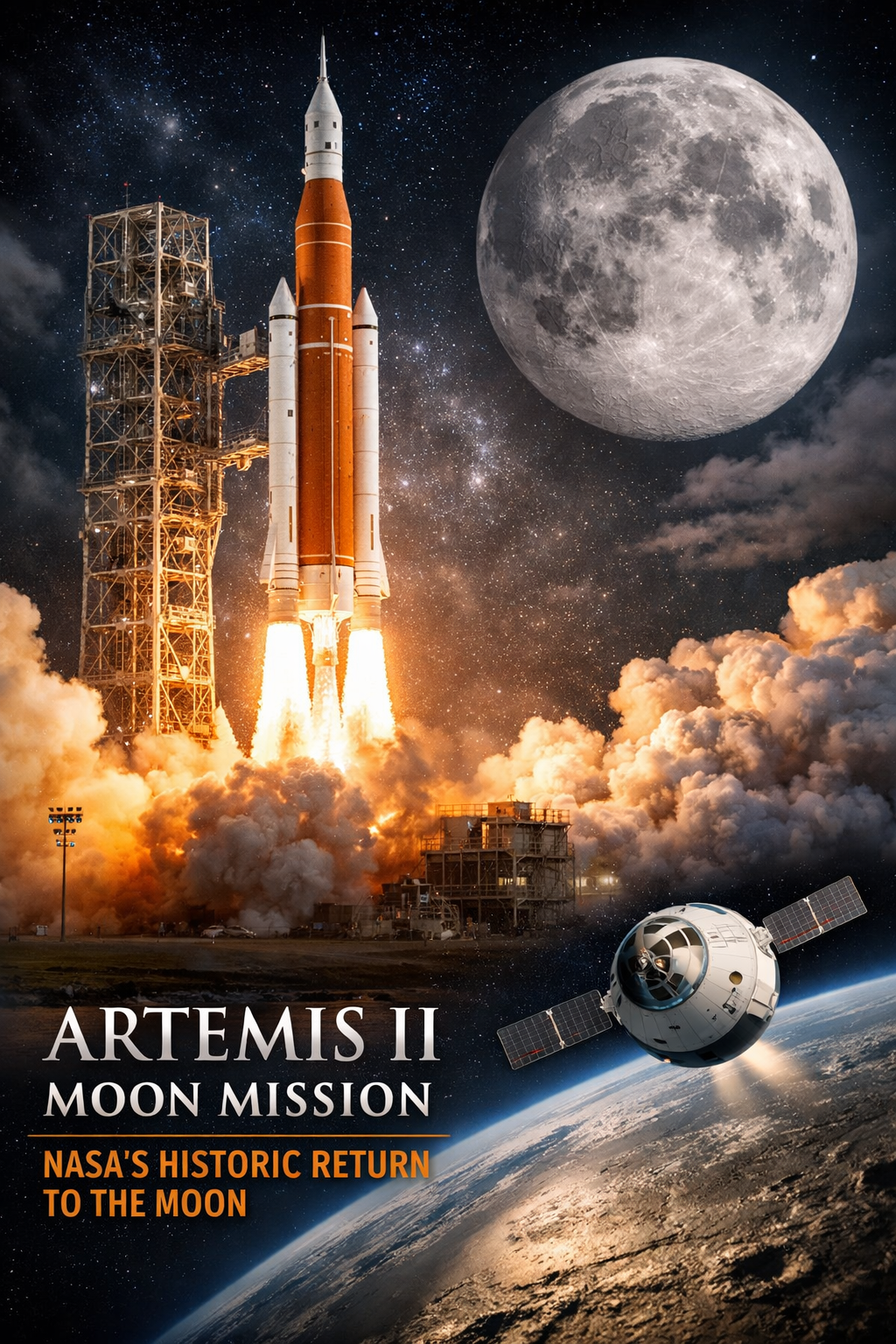
Artemis II Marks Historic Return to the Moon After 50 Years: A New Era of Human Space Exploration
In a landmark moment for global space exploration, the NASA has launched its first crewed lunar mission in over five decades under the ambitious Artemis II program. The mission represents a significant leap forward in humanity’s quest to return to the Moon and eventually venture beyond, including future missions to Mars.
Launched from the iconic Kennedy Space Center in Florida, the mission lifted off successfully aboard the powerful Space Launch System (SLS) rocket, carrying the Orion spacecraft with four astronauts onboard. The launch marks the first time since the historic Apollo 17 mission in 1972 that humans are traveling toward the Moon.
A Long-Awaited Return to Deep Space
The Artemis II mission symbolizes more than just a return to the Moon—it represents the revival of human deep space exploration. For decades, space agencies have focused primarily on low Earth orbit missions, such as those involving the International Space Station. However, Artemis II shifts that focus outward, aiming to establish a sustained human presence on the Moon and pave the way for future interplanetary travel.
The mission is scheduled to last approximately ten days, during which the crew will perform a lunar flyby, traveling farther from Earth than any humans have ever gone before. This trajectory will test both the spacecraft and human endurance in deep space conditions, making it a crucial step toward more complex missions in the Artemis program.
The Crew: A Diverse Team of Explorers
The Artemis II crew consists of four highly trained astronauts:
Christina Koch
Victor Glover
Reid Wiseman
Jeremy Hansen
This team reflects a new era of inclusivity and international collaboration in space exploration. Christina Koch is set to become the first woman to travel to the Moon, while Victor Glover will be the first Black astronaut on a lunar mission. Jeremy Hansen, representing Canadian Space Agency, highlights the mission’s international dimension.
NASA officials have emphasized the importance of this diverse crew, noting that it represents humanity as a whole rather than a single nation. Their journey is expected to inspire millions worldwide and reignite public interest in space exploration.
Overcoming Technical Challenges
The path to launch was not without obstacles. The Artemis II mission faced multiple delays due to technical challenges, particularly involving the SLS rocket and Orion spacecraft systems. Engineers had to address issues related to hydrogen fuel leaks, sensor malfunctions, and system integration complexities.
Each delay, however, underscored NASA’s commitment to safety and precision. Unlike earlier eras of space exploration, modern missions undergo rigorous testing and validation processes to minimize risks. The successful resolution of these issues ultimately led to a smooth launch, with all systems performing as expected.
Weather conditions also played a critical role. Although clouds briefly hovered over the launch site, conditions remained within acceptable limits, allowing the countdown to proceed without interruption. The fueling process, particularly with liquid hydrogen, was completed successfully—a major milestone given previous complications.
The Mission Profile: A Ten-Day Journey
Artemis II is designed as a test mission, but its scope is vast. After liftoff, the Orion spacecraft will undergo a series of system checks while in Earth orbit. Once verified, the spacecraft will perform a translunar injection, propelling it toward the Moon.
The mission will include:
Launch and Earth Orbit Testing
Translunar Injection Burn
Lunar Flyby
Deep Space Navigation Tests
Return Trajectory and Re-entry
Splashdown in the Pacific Ocean
The lunar flyby will allow the spacecraft to use the Moon’s gravitational pull to slingshot back toward Earth. This technique, known as a free-return trajectory, ensures that the spacecraft can safely return even in the event of system failures.
International Collaboration: Europe’s Key Role
The Artemis II mission is not solely an American endeavor. The European Space Agency (ESA) plays a vital role, particularly through its contribution to the Orion spacecraft.
The service module, developed by ESA and built by Airbus in Bremen, Germany, provides critical functions such as propulsion, power, and life support. This collaboration underscores the growing importance of international partnerships in advancing space exploration.
ESA Director General Josef Aschbacher described Artemis II as a “milestone moment” not only for human exploration but also for Europe’s role in shaping the future of space travel.
Why Artemis II Matters
The significance of Artemis II extends far beyond its immediate objectives. It serves as a foundational step in NASA’s broader Artemis program, which aims to:
Return humans to the Moon sustainably
Establish a lunar base camp
Develop technologies for Mars exploration
Foster international cooperation
Unlike the Apollo missions, which were largely driven by geopolitical competition during the Cold War, Artemis represents a collaborative and forward-looking approach. It integrates contributions from multiple countries and private companies, creating a more inclusive framework for space exploration.
Technological Advancements
The Artemis II mission showcases several technological advancements that distinguish it from previous lunar missions:
1. Advanced Rocket System
The SLS is the most powerful rocket ever built by NASA, capable of carrying heavier payloads and enabling deeper space missions.
2. Next-Generation Spacecraft
The Orion capsule is equipped with modern avionics, improved life support systems, and enhanced safety features.
3. Deep Space Navigation
The mission will test new navigation systems designed for long-duration space travel, crucial for future Mars missions.
4. Re-entry and Heat Shield Testing
Orion’s heat shield will undergo extreme conditions during re-entry, providing valuable data for future missions.
Public Engagement and Global Interest
The launch of Artemis II was broadcast live on NASA’s official platforms, including its widely followed YouTube channel. Millions of viewers from around the world tuned in to witness the historic event, reflecting renewed global interest in space exploration.
Social media platforms were flooded with reactions, with many users expressing excitement and pride. The mission has also sparked discussions about the future of humanity in space, including the possibility of lunar tourism and commercial space ventures.
Looking Ahead: The Future of Artemis
Artemis II is just the beginning. The next mission, Artemis III, aims to land astronauts on the lunar surface, including the first woman and the first person of color. This will mark humanity’s return to the Moon’s surface after more than half a century.
Future missions will focus on building infrastructure such as the Lunar Gateway—a space station orbiting the Moon—and establishing a sustainable human presence. These efforts will serve as a testing ground for technologies needed for Mars exploration.
A New Chapter in Human Exploration
The successful launch of Artemis II marks a turning point in the history of space exploration. It bridges the legacy of the Apollo era with the possibilities of the future, demonstrating that humanity’s ambition to explore the cosmos remains as strong as ever.
As the Orion spacecraft journeys through deep space, it carries not only four astronauts but also the hopes and aspirations of millions. The mission serves as a reminder that exploration is a fundamental part of human nature—and that the Moon is just the beginning.
In the words of NASA officials, Artemis II is not merely a mission; it is a statement of intent—a declaration that humanity is ready to venture beyond Earth once again, united in the pursuit of knowledge and discovery.
Conclusion
With Artemis II, NASA and its international partners have taken a bold step toward redefining humanity’s place in the universe. The mission encapsulates decades of technological progress, international cooperation, and unwavering determination.
As the spacecraft arcs around the Moon and heads back to Earth, it will leave behind more than just a trail through space—it will mark the beginning of a new era, one where humanity looks beyond its home planet and dares to explore the unknown once more.