Gaza Humanitarian Crisis Deepens as Winter Floods Displace Families
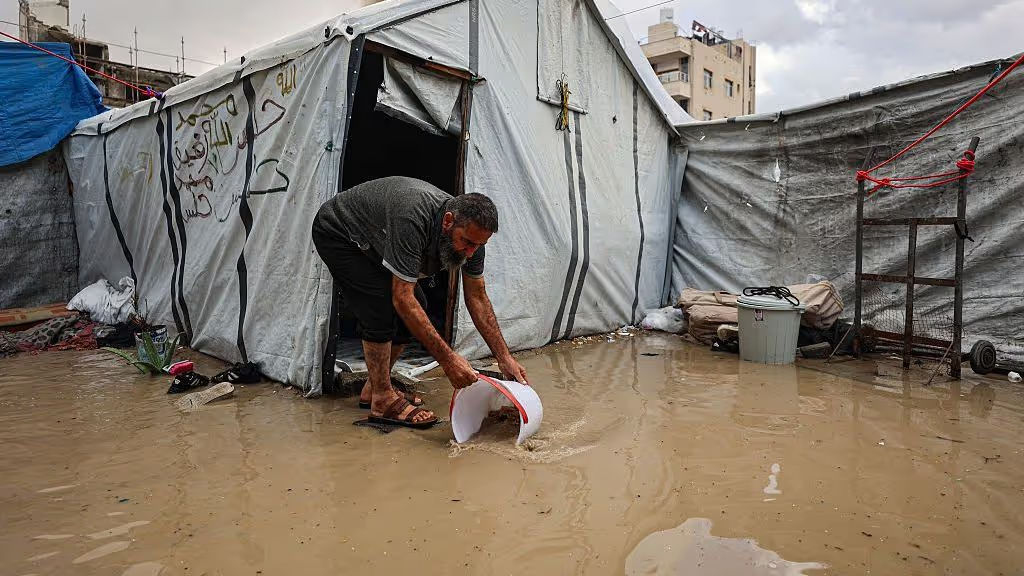
Gaza's humanitarian emergency is entering another dangerous phase as heavy rainfall, falling temperatures and widespread flooding damage thousands of shelters housing displaced Palestinian families. Tents have been submerged, sanitation systems overwhelmed and essential services disrupted, leaving hundreds of thousands of people exposed to contaminated water, illness and the approaching winter. The crisis is unfolding alongside a political deadlock between Israel and Hamas over disarmament, military withdrawal and the future governance of Gaza, preventing meaningful progress towards reconstruction and a lasting recovery.
The United Nations Office for the Coordination of Humanitarian Affairs (OCHA) has reported that more than 46,000 households may have been affected by the recent rainfall, with over 40,000 shelters reported damaged. Thousands of families have been left without adequate protection, while humanitarian organisations struggle to provide emergency assistance because of restrictions, limited supplies and funding shortages.
The situation is particularly alarming because most of Gaza's population has already experienced repeated displacement during the war. Many families are living in temporary tents, damaged buildings or overcrowded camps with inadequate drainage, sanitation and access to essential services. For these households, even ordinary seasonal rainfall can become a life-threatening emergency.
Humanitarian organisations warn that the combination of flooding, poor shelter conditions, medicine shortages and limited access to aid could create an even more serious public-health emergency as temperatures continue to fall.
Key Developments in Gaza's Humanitarian Crisis
- Flooding: More than 46,000 households, representing approximately 226,000 people, may have been affected by heavy rainfall.
- Shelter damage: More than 40,000 shelters were reported damaged, including over 9,000 reportedly destroyed beyond repair.
- Casualties: Gaza's Ministry of Health reported 22 Palestinians killed and 90 injured in conflict-related incidents during the reporting period.
- Humanitarian deliveries: The number of aid trucks offloaded in Gaza fell by approximately 42 per cent compared with the previous week.
- Public health: Sewage-contaminated floodwater, overcrowding and medicine shortages are increasing health risks.
- Education: Flooding affected 109 learning spaces, leaving at least 5,500 children unable to access education.
- Political deadlock: Disagreements over Hamas disarmament, Israeli troop withdrawal and Gaza's future governance continue to obstruct reconstruction.
- Winter supplies: Aid organisations warn that available winter clothing, blankets and adequate shelter remain far below the needs of displaced families.
- West Bank: Demolitions, settler violence and access restrictions continue to displace Palestinian families and disrupt daily life.
Heavy Rain Turns Displacement Camps Into Flooded Settlements
The latest rainfall has exposed the extreme vulnerability of Gaza's temporary shelters. Since the beginning of the heavy rain, thousands of tents and makeshift living spaces have been damaged by flooding, leaving families struggling to protect their belongings and find dry places to sleep.
According to OCHA's situation report, the Site Management Cluster recorded approximately 473 alerts related to the rainfall between the start of the weather emergency and the latest assessment. These alerts indicated that more than 46,000 households, or approximately 226,000 people, may have been affected.
More than 40,000 shelters were reported damaged, including over 9,000 that were reportedly destroyed beyond repair. The reported damage also included 960 latrines and nine health facilities. These figures were based on alerts and assessments that were still being verified, meaning the final impact could change as more information becomes available.
The flooding has been particularly devastating for families living in low-lying areas and overcrowded displacement sites. Many shelters were already weakened by prolonged use, exposure to previous weather conditions and a lack of replacement materials.
Families have attempted to protect their tents using sand, rubble and plastic coverings, but these measures provide limited protection when heavy rain continues for several days. Waterlogged ground, damaged drainage channels and inadequate sanitation have made several camps increasingly difficult to inhabit.
DW also reported local estimates that tens of thousands of tents had been flooded, affecting more than 200,000 people. The accounts of displaced residents describe families attempting to dry clothes and bedding while children struggle against cold temperatures and damp conditions.
The destruction of temporary shelters is especially serious because many families have nowhere else to go. With large areas inaccessible and many residential buildings damaged or destroyed, relocating people away from flood-prone locations remains extremely difficult.
Children and Families Face a Dangerous Winter
The approaching winter is increasing pressure on an already exhausted population. Displaced families are facing cold nights without sufficient blankets, warm clothing, waterproof shelters or reliable heating.
Save the Children has warned that approximately 1.2 million people in Gaza, including more than 560,000 children, are living in critical or catastrophic shelter conditions. The organisation's regional director, Ahmad Alhendawi, told DW that available winter clothing supplies remain critically insufficient.
The shortage is particularly concerning for children, who are more vulnerable to the effects of prolonged exposure to cold and damp environments. Without adequate clothing, blankets and dry sleeping spaces, children face increased risks of hypothermia, respiratory infections and other preventable illnesses.
The problem extends beyond the immediate discomfort of cold weather. Repeated exposure to damp conditions can weaken health, worsen existing medical problems and make it harder for families to recover from infections.
Pregnant women, newborn babies, older people and individuals with disabilities face additional challenges. UNFPA representative Nestor Owomuhangi told DW that approximately 400,000 people continue to live in areas at high risk of flooding, including an estimated 10,000 pregnant women.
He also highlighted the needs of mothers and newborns, noting that around 180 babies are born every day in Gaza. These families urgently require dry and warm shelter, access to medical services and essential supplies.
Contaminated Floodwater Raises the Risk of a Public-Health Emergency
One of the most serious consequences of the flooding is the contamination of standing water. Damaged sewage networks and overwhelmed drainage systems have allowed wastewater to mix with rainwater in several areas.
OCHA has warned that this mixture creates significant public-health risks. People living in flooded displacement sites may come into contact with contaminated water while attempting to move through camps, protect their belongings or reach food and medical services.
The situation is especially dangerous for children, who may be exposed to contaminated water while playing or moving around crowded shelters. Poor sanitation also increases the risk of waterborne diseases and infections.
The flooding has placed additional pressure on Gaza's already damaged water and sanitation infrastructure. In some locations, stormwater systems have struggled to cope with the volume of rain, while sewage networks remain affected by years of damage and inadequate maintenance.
The Water, Sanitation and Hygiene Cluster reported that water levels at Sheikh Radwan Lagoon had risen by nearly 1.5 metres, placing additional pressure on pumping systems. A further period of intense rainfall could cause the lagoon to overflow and worsen contamination risks.
Humanitarian teams have been clearing blocked sewer lines, stormwater basins and drainage channels. OCHA reported that work at 60 locations had benefited an estimated 30,000 families, but the scale of the emergency means that these interventions are not sufficient to address every affected area.
The availability of dewatering pumps, sandbags and other equipment remains limited. Without additional machinery and essential maintenance materials, humanitarian teams may struggle to prevent further flooding if heavy rain returns.
Health Facilities Struggle With Medicine Shortages and Rising Disease
Gaza's healthcare system is facing another major challenge as flooding disrupts medical services and increases demand for treatment. Several facilities have been affected by poor access conditions, while damaged roads and standing water make it harder for patients and medical workers to reach hospitals and clinics.
OCHA reported that approximately 42 per cent of essential medicines were at zero-stock levels during October. The shortages also affected specialist treatments, including chemotherapy medicines and supplies used for open-heart surgery and cardiac catheterisation.
Laboratory supplies needed for kidney and liver function testing, electrolyte monitoring and diabetes diagnosis were also in critically short supply. These shortages make it more difficult for healthcare workers to diagnose and treat patients who require regular monitoring.
The situation is particularly concerning for people with chronic illnesses. Patients who depend on regular medication may face interruptions in treatment, while individuals requiring dialysis, cancer care or cardiac services need specialised supplies that are difficult to replace.
The report also highlighted an increase in probable meningitis cases. During epidemiological weeks 40 to 44, covering late September through October, health authorities recorded 294 probable viral cases and 119 probable bacterial cases. A large proportion of the recorded cases were in Gaza governorate.
Among the individually documented cases, most involved infants under one year of age. Health specialists have linked the increase to overcrowded tents and schools, deteriorating shelter conditions, poor sanitation and exposure to unsafe water.
These conditions create an especially dangerous environment for infants and young children, whose immune systems are more vulnerable to infectious diseases.
The healthcare system is also struggling with limited hospital capacity. OCHA reported that only around 90 paediatric inpatient beds remained operational in Gaza and North Gaza, compared with approximately 350 before the escalation.
Humanitarian organisations expect acute respiratory infections, waterborne diseases and hypothermia to increase as winter conditions worsen. Without additional medicines, equipment and functioning medical facilities, the ability to respond to a surge in illness remains severely constrained.
Humanitarian Aid Deliveries Fall as Access Restrictions Continue
The worsening humanitarian situation is being compounded by difficulties in bringing supplies into Gaza. Aid organisations require a consistent flow of food, shelter materials, medical equipment, fuel and sanitation supplies to support the population.
However, OCHA reported that the number of humanitarian trucks offloaded on the Israeli side of the Kerem Shalom crossing fell by approximately 42 per cent compared with the previous week.
Between the relevant reporting periods, 262 United Nations and partner trucks carrying humanitarian supplies were manifested for entry into Gaza. Of these, 228 were offloaded on the Israeli side of Kerem Shalom.
The reduction was mainly attributed to the suspension of the Egyptian corridor by Israeli authorities, who reportedly cited concerns about smuggling. No trucks were offloaded through that corridor during the period from 3 to 8 November.
Overall aid deliveries were also affected by reduced supplies available to humanitarian partners because of funding constraints.
These difficulties come at a time when the need for assistance is increasing. Families require replacement tents, tarpaulins, blankets, mattresses, hygiene kits and winter clothing. Health facilities need medicines, laboratory supplies, fuel and maintenance equipment, while sanitation teams require pumps and machinery to clear floodwater.
The restrictions and funding shortages have therefore created a difficult situation in which humanitarian organisations are being asked to respond to a growing emergency with limited resources.
What Humanitarian Organisations Need Most
- Weather-resistant tents and emergency shelter materials.
- Tarpaulins, blankets, mattresses and warm clothing.
- Medical supplies, essential medicines and laboratory equipment.
- Fuel, generators, batteries and spare parts for essential services.
- Water pumps, drainage equipment and sanitation materials.
- Food, clean drinking water and hygiene kits.
- Reliable humanitarian access and sufficient funding to maintain emergency operations.
Humanitarian Teams Work to Restore Basic Services
Despite severe operational difficulties, humanitarian organisations continue to provide emergency support across Gaza. Their work includes distributing shelter materials, clearing drainage channels, removing floodwater and helping families access medical and protection services.
Between 2 and 9 November, Shelter Cluster partners distributed shelter and non-food items to approximately 10,690 households. Assistance included tarpaulins, emergency housing materials, tents, kitchen sets, winter clothing kits, mattresses, blankets and plastic sheets.
More than half of those households were reached on a single day during the reporting period, including families affected by the recent rainfall.
Water and sanitation teams deployed heavy machinery to displacement sites to remove floodwater, clear drainage channels and improve ground conditions. Their operations reached thousands of families, while additional teams worked to unblock sewage systems and stormwater basins.
Fifteen dewatering pumps were being used by WASH teams, alongside the distribution and installation of sandbags. These activities are intended to reduce standing water and limit the spread of contamination.
Health partners have also carried out drainage work, temporary repairs, flood barriers and weatherproofing at medical facilities. UNRWA opened a new health centre in Gaza to provide maternal and child healthcare, nutrition support and psychosocial assistance to a large surrounding population.
Protection organisations continue to provide emergency referrals, legal assistance, case management and mental-health support. However, damaged shelters and inaccessible roads have made it harder for staff to reach some communities.
These efforts demonstrate that humanitarian assistance is continuing, but they also reveal the enormous difference between emergency response and a sustainable recovery. Clearing water from a camp may provide temporary relief, but families still need safe housing, functioning infrastructure and reliable access to essential services.
Thousands of Children Lose Access to Education
The flooding has also disrupted education for thousands of children who were already facing prolonged interruptions to their schooling.
OCHA reported that rainfall affected 109 learning spaces across Gaza. At least 5,500 children remained unable to access education because their learning facilities had been damaged or become inaccessible.
The affected locations included classrooms, temporary learning structures and tents used to provide educational services to displaced children. Some facilities experienced flooding, leaking roofs, damaged infrastructure and unsafe access routes.
In several cases, displaced families were forced to use temporary learning spaces as shelters. This meant that educational activities had to be suspended while the facilities accommodated people who had nowhere else to go.
The disruption comes after years in which children have experienced interrupted education, displacement and psychological distress. For many, temporary learning centres provide more than academic instruction: they offer routine, social interaction and a degree of stability during an uncertain period.
Rainfall also damaged 15 safe spaces, child-friendly spaces and psychosocial support tents. The damage forced the suspension of activities designed to support children and families dealing with the consequences of war and displacement.
The collapse of a safe space serving women and girls at Palestine Camp Stadium in Gaza city also disrupted access to services for more than 200 women. These facilities are important for providing protection, counselling and assistance to people facing heightened risks during displacement.
Political Deadlock Continues to Block Gaza's Reconstruction
While humanitarian organisations are trying to address the immediate consequences of flooding, political disagreements continue to obstruct longer-term recovery.
The ceasefire arrangement established through US-led diplomacy was intended to create a framework for reducing violence, addressing security concerns and preparing for Gaza's postwar future. However, major disagreements remain between Israel and Hamas over the terms of disarmament, the withdrawal of Israeli forces and the transfer of governing authority.
These disputes have prevented meaningful progress on reconstruction and the establishment of a stable political arrangement. Although the ceasefire has reduced the scale of fighting compared with the most intense phases of the war, Israeli military strikes have continued.
DW reported that the Board of Peace, established by US President Donald Trump to oversee implementation of the ceasefire and Gaza's postwar governance, has struggled to make progress.
The Board of Peace has called on Israel to authorise and facilitate the entry of necessary winterisation and humanitarian supplies. It has also urged Hamas to meet its commitments under the ceasefire, including laying down its weapons and transferring governing authority.
Hamas has rejected the criticism and accused Israel of obstructing implementation of the peace plan and withholding urgently needed humanitarian supplies.
Israel, meanwhile, has argued that restrictions are necessary because of security concerns and the possibility that materials entering Gaza could be diverted for military purposes. Israeli Prime Minister Benjamin Netanyahu has rejected responsibility for the worsening humanitarian conditions and blamed Hamas.
The competing positions have left reconstruction efforts caught between political demands and the immediate needs of civilians. While negotiations remain unresolved, families continue to live in damaged homes, temporary camps and unsafe buildings.
Rebuilding Gaza Could Cost More Than $71 Billion
The scale of destruction across Gaza means that reconstruction will require enormous financial resources and long-term international coordination.
A joint assessment by the World Bank, the United Nations and the European Union estimated that Gaza's recovery and reconstruction would require approximately $71.4 billion over the next decade.
The estimated cost reflects the extensive damage to housing, infrastructure, healthcare, education, water systems and other essential services. Rebuilding will require more than replacing damaged buildings. It will involve restoring the systems that allow communities to function and economies to recover.
Roads, electricity networks, hospitals, schools, water facilities and sanitation infrastructure will all require substantial investment. Businesses and public institutions will also need support to resume operations and provide employment.
However, reconstruction cannot move forward at the required scale without agreements on security, access, governance and the entry of construction materials.
The disagreement over Hamas disarmament and the presence of Israeli forces has become one of the central obstacles. Israel has linked progress to security conditions, while Hamas has rejected demands that it surrender its weapons under the current circumstances.
The result is a prolonged political impasse in which the practical requirements of rebuilding homes and essential services remain secondary to unresolved political and security questions.
Disagreement Over Winter Supplies and Humanitarian Access
The question of winter supplies has become particularly urgent as humanitarian agencies warn that existing shelter conditions are inadequate for the colder months.
The Board of Peace has publicly called for Israel to facilitate the entry of essential winterisation materials. These include tents, blankets, tarpaulins, clothing and equipment needed to protect families from rain and low temperatures.
Israeli authorities have stated that substantial quantities of supplies have entered Gaza in recent months. The Coordinator of Government Activities in the Territories, known as COGAT, said that 91,000 tents and more than 8,200 trucks carrying tarpaulins, blankets and winter clothing had entered the territory.
COGAT also said that sewage vacuum trucks and other equipment had arrived to support sanitation operations.
However, the United Nations and humanitarian organisations have continued to raise concerns about access to essential materials. The UN has said that approximately 150,000 tents were outside Gaza and ready to be dispatched, pending the necessary approvals. Israel has rejected allegations that it is systematically preventing the entry of prefabricated shelters.
The disagreement highlights a wider problem: governments and humanitarian agencies are presenting different accounts of supply availability, access restrictions and the scale of unmet needs.
For displaced families, the immediate issue is whether sufficient materials can reach them before winter conditions become more severe.
The Yellow Line and Restrictions on Movement
Access restrictions have also complicated efforts to relocate families away from dangerous areas. The military demarcation known as the Yellow Line separates areas under Israeli military control from other parts of Gaza.
OCHA has warned that restrictions on access behind the line leave much of the territory unavailable to Palestinians and humanitarian organisations. This limits the areas where families can move, where relief operations can take place and where damaged infrastructure can be assessed or repaired.
The restrictions are particularly significant during flooding because families living in low-lying or damaged areas may have limited options for relocation.
Humanitarian partners have warned that there is insufficient space to move everyone living in flooded sites or unsafe buildings. The combination of restricted access, destroyed housing and overcrowded displacement camps leaves many families exposed to continued danger.
The situation also makes it more difficult for aid organisations to deliver supplies consistently and assess the full scale of damage.
The West Bank Faces a Separate but Connected Humanitarian Crisis
The humanitarian situation is also deteriorating in the occupied West Bank, where demolitions, settler violence and movement restrictions continue to affect Palestinian communities.
OCHA reported that demolitions by Israeli forces displaced approximately 150 Palestinians during one week. The affected areas included locations connected to the E1 settlement expansion plan, the Jordan Valley and East Jerusalem.
Education-related incidents also increased significantly. During the third quarter of the year, incidents affecting schools and educational access nearly doubled compared with the same period in the previous year.
The reported incidents affected 149 schools and nearly 28,000 students and education personnel across the West Bank.
Settler violence and access restrictions have continued to disrupt Palestinian livelihoods, particularly during the olive harvest. OCHA recorded 410 harvest-related settler attacks since the beginning of September.
These incidents have involved threats, violence and damage affecting Palestinian farmers and their property. Restrictions on movement and access to agricultural land can prevent families from harvesting crops that provide an important source of income.
The developments underline that humanitarian concerns extend beyond Gaza. Palestinian communities across the occupied territory continue to face displacement, insecurity and restrictions affecting access to homes, education and livelihoods.
Why the Humanitarian Crisis Is Becoming More Difficult to Resolve
Gaza's worsening conditions are the result of several interconnected problems rather than a single emergency. Flooding has intensified the damage, but the underlying vulnerabilities existed long before the latest rainfall.
Years of conflict have damaged housing, roads, hospitals, water networks and sanitation systems. Repeated displacement has forced families into temporary shelters that are often overcrowded and poorly equipped to withstand severe weather.
Humanitarian access restrictions and funding shortages make it harder to replace damaged supplies and repair essential infrastructure. At the same time, political disagreements prevent a clear path towards reconstruction and stable governance.
These challenges reinforce one another. Damaged sanitation systems increase the risk of disease, while medicine shortages make those illnesses harder to treat. Flooded roads prevent patients from reaching hospitals, and damaged shelters expose families to further health risks.
Without reliable access to construction materials and equipment, temporary repairs cannot develop into lasting solutions. Humanitarian agencies can distribute blankets and remove floodwater, but they cannot rebuild an entire territory without the necessary political agreements, resources and access.
What Happens Next for Gaza?
The immediate priority is to protect displaced families from further flooding and cold weather. Humanitarian organisations need access to sufficient tents, tarpaulins, blankets, warm clothing, medicines and sanitation equipment.
Emergency teams will also need to continue clearing drainage systems, removing contaminated water and restoring essential services in affected displacement sites. Medical facilities require additional medicines, laboratory supplies, fuel and equipment to prepare for a possible increase in winter-related illness.
Education and protection services must also be restored where flooding has damaged temporary facilities. Children need safe learning spaces, while women and vulnerable groups require access to protection services and psychosocial support.
Beyond the emergency response, progress will depend on whether the parties can resolve disagreements over disarmament, military withdrawal, governance and humanitarian access.
The international community will also face pressure to turn reconstruction pledges into practical support. The estimated $71.4 billion recovery requirement cannot be addressed without sustained funding, reliable access to materials and a political framework that allows rebuilding to proceed.
The Board of Peace, the United Nations and other international partners will be under pressure to demonstrate that diplomatic commitments can produce tangible improvements in the lives of civilians.
A Humanitarian Emergency Caught Between the Weather and Politics
Gaza's latest flooding has revealed how fragile life remains for hundreds of thousands of displaced people. Rain that would ordinarily be a seasonal inconvenience has become a serious threat because families lack secure housing, functioning sanitation systems and reliable access to essential services.
The damage to tens of thousands of shelters, the shortage of medicines and the growing risks of disease show that the humanitarian emergency is far from over. Children are losing access to education, pregnant women face dangerous living conditions and families are struggling to protect themselves from cold and contaminated water.
Humanitarian organisations are continuing to provide assistance, but their work is constrained by limited supplies, funding shortfalls and restrictions on access. Meanwhile, political disagreements over the ceasefire and Gaza's future are preventing the reconstruction process from moving forward at the pace required.
The coming weeks will be critical. Without a significant improvement in humanitarian access, winter supplies and emergency shelter, the effects of flooding could continue to spread through an already vulnerable population.
Gaza's crisis is no longer defined only by the destruction left by war. It is also a struggle for shelter, clean water, healthcare and protection from the elements. As families face another winter in damaged tents and unsafe buildings, the gap between diplomatic promises and conditions on the ground remains painfully clear. Until humanitarian access improves and political progress allows reconstruction to begin, thousands of families will continue to face an emergency that neither the weather nor the passing of time will resolve on its own.
Keywords:
Related Posts