Donald Trump is attempting to create a large-scale database of voters, raising concerns among election officials about how he might use that information.
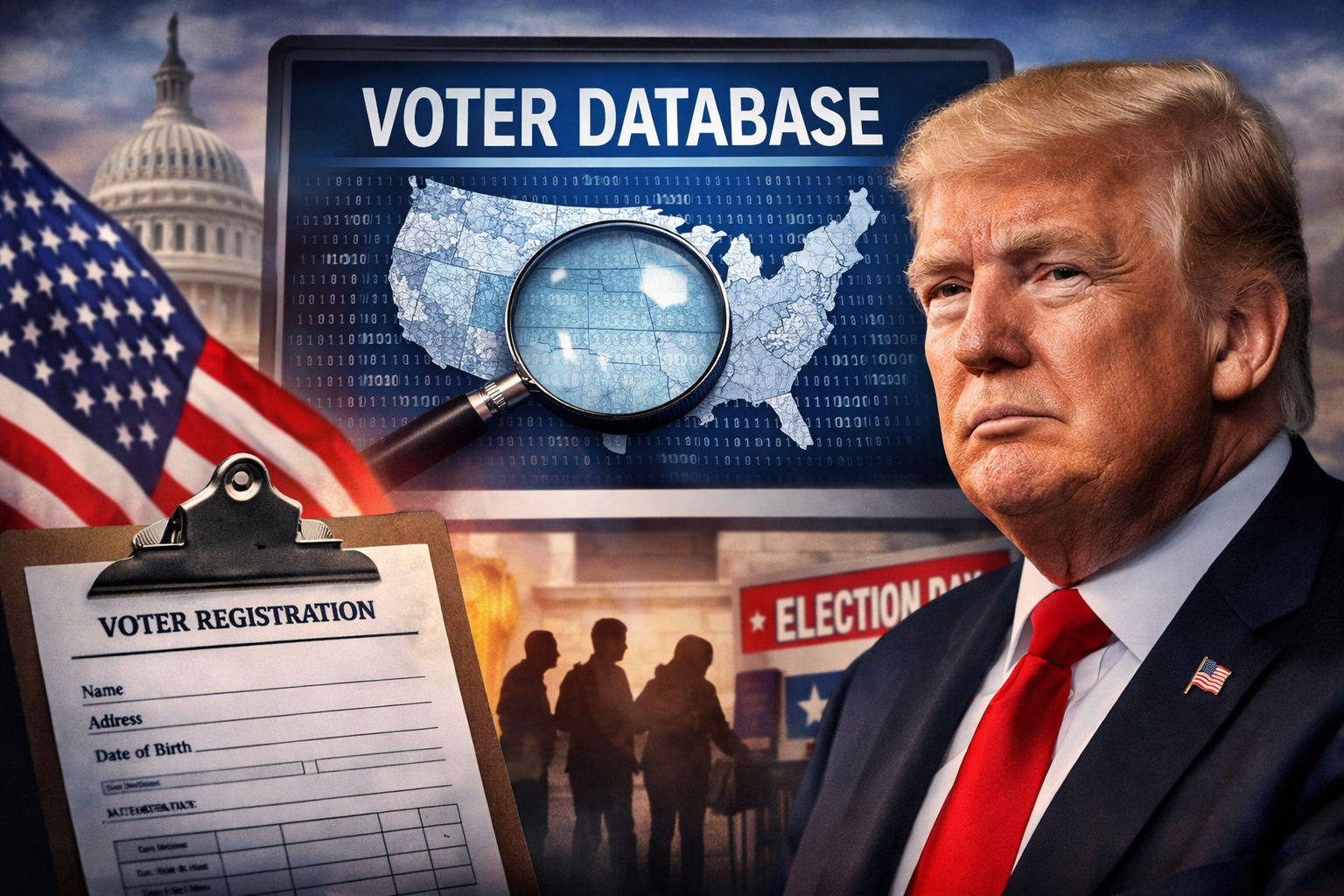
Trump Administration Pushes National Voter Database, Raising Alarm Over Election Integrity and Civil Rights
The administration of Donald Trump has significantly intensified its efforts to investigate alleged voter fraud, taking aggressive steps that critics warn could reshape the structure of U.S. elections. At the center of this campaign is a controversial push to build what appears to be a nationwide voter database—an initiative that has sparked concern among election officials, civil rights advocates, and legal experts.
Framed under the banner of “election integrity,” the administration’s actions include a sweeping executive order, legal battles with dozens of states, and new coordination between federal agencies. While supporters argue these efforts are necessary to prevent noncitizen voting, opponents fear the initiative could disenfranchise eligible voters and undermine trust in democratic institutions ahead of the 2026 midterm elections.
Expanding Federal Reach Into Election Systems
In a major development, the Department of Justice (DOJ) has finalized an agreement with the Department of Homeland Security (DHS) to share sensitive voter registration data collected from states. This data will be cross-checked using a federal citizenship verification system, a move that has raised red flags due to concerns about the system’s accuracy.
Historically, voter registration and election administration have been managed at the state level, as outlined in the U.S. Constitution. However, the Trump administration’s latest actions suggest a shift toward greater federal control, with the goal of identifying individuals who may not be eligible to vote.
Critics argue that this approach risks overreach and could violate constitutional boundaries. Election experts note that the federal government lacks both the authority and the comprehensive data needed to accurately determine voter eligibility nationwide.
Legal Pressure on States Intensifies
The administration has filed lawsuits against 30 states and the District of Columbia, accusing them of refusing to provide unredacted voter registration lists. These lawsuits mark a significant escalation in the administration’s campaign to obtain detailed voter data.
During a court hearing on March 26, a DOJ lawyer acknowledged for the first time that the data would be used by DHS to identify potentially ineligible voters. This admission contradicted earlier assurances that the administration was not attempting to build a centralized voter registry.
Many states have resisted these demands, citing privacy concerns and the risk of misuse of sensitive information. Some officials worry that handing over complete voter rolls could expose citizens to political targeting or erroneous removal from voter lists.
Proposed Funding Leverage Raises New Concerns
In a move that has drawn sharp criticism, administration officials have explored conditioning federal homeland security funding on states’ willingness to share voter data. The idea was reportedly discussed during a call involving the Federal Emergency Management Agency (FEMA).
According to sources familiar with the discussion, states that refuse to comply could risk losing hundreds of millions of dollars in grants. While DHS has stated that no changes to funding policies have been finalized, the proposal has heightened tensions between federal and state governments.
Critics view this as a coercive tactic that could force states to comply with controversial federal demands, potentially compromising voter privacy and election integrity.
Role of Key Figures and Agencies
The administration has also taken steps to strengthen its internal focus on election-related investigations. Former Attorney General Pam Bondi recently appointed Dan Bishop, a federal prosecutor who has previously questioned the results of the 2020 election, to oversee efforts related to voter data analysis.
Bishop’s role includes examining voter registration data and identifying suspected noncitizen voters. This development has raised concerns among critics who argue that the initiative is politically motivated rather than evidence-based.
Additionally, DHS has brought in individuals like Heather Honey, known for skepticism about election results, to work on “election integrity” initiatives. Their involvement has further fueled debate about the objectivity and intent of the administration’s efforts.
Questions Over Data Accuracy and Misuse
One of the central concerns surrounding the administration’s initiative is the reliability of the data being used. The citizenship verification system at the heart of the effort—known as SAVE (Systematic Alien Verification for Entitlements)—has faced criticism for producing inaccurate results.
Experts warn that outdated or incomplete data can lead to false identification of citizens as noncitizens. This risk is particularly significant for naturalized citizens whose updated status may not be reflected in federal databases.
Elisabeth Frost of the Elias Law Group emphasized the dangers of misinterpreting data, stating that flawed methodologies could be used to “tell a completely false story.” Critics fear that such inaccuracies could be used to justify voter purges or cast doubt on election outcomes.
Evidence From State-Level Use
Some states have already used the SAVE system to verify voter eligibility, with mixed results. In Texas, officials identified thousands of potential noncitizens on voter rolls. However, further investigation revealed that many of those flagged were, in fact, eligible voters.
In Travis County, for example, several individuals initially identified as noncitizens had already provided valid proof of citizenship. This highlights the limitations of relying solely on federal databases without thorough verification processes.
Such cases have strengthened arguments that the system is not reliable enough to support large-scale federal initiatives.
Executive Order Signals Broader Ambitions
A recent executive order signed by Donald Trump has further intensified concerns. The directive aims to create “citizenship lists” by combining data from multiple federal sources, including Social Security records and naturalization databases.
This move represents the clearest indication yet that the administration is pursuing a centralized system for determining voter eligibility. Critics argue that this approach undermines the role of states and could lead to widespread disenfranchisement.
Legal experts expect the executive order to face significant challenges in court, similar to previous election-related directives issued by the administration.
Broader Political Context
The administration’s actions come amid ongoing claims by Donald Trump that U.S. elections are affected by widespread fraud, particularly involving noncitizen voting. However, numerous studies and investigations have found little evidence to support these claims.
Under federal law, noncitizens are prohibited from voting in national elections and face severe penalties, including prosecution and deportation, if they do so. Voters are also required to affirm their citizenship under penalty of perjury.
Despite these safeguards, the administration has continued to emphasize the need for stricter enforcement measures, arguing that they are essential for maintaining public confidence in elections.
Legislative Challenges and Political Divide
Efforts to pass comprehensive election reform legislation, such as the SAVE America Act, have faced significant obstacles in Congress. Republicans have shown reluctance to alter Senate rules to advance the bill, while Democrats have strongly opposed measures they view as restrictive.
As a result, the administration has turned to executive actions and legal strategies to pursue its objectives. This approach has deepened political divisions and raised questions about the balance of power between federal and state governments.
Legal Battles and Future Outlook
The administration’s initiatives have already prompted multiple lawsuits from states, advocacy groups, and civil rights organizations. These legal challenges argue that the federal government is exceeding its authority and risking voter disenfranchisement.
Election experts predict that courts may block key aspects of the administration’s plans, particularly those that attempt to centralize control over voter registration and eligibility.
However, the outcome of these legal battles remains uncertain, and the administration appears committed to continuing its efforts.
Conclusion
The Trump administration’s push to build a national voter database marks a significant shift in the landscape of U.S. elections. While framed as an effort to ensure election integrity, the initiative has raised serious concerns about voter privacy, data accuracy, and the potential for disenfranchisement.
As legal challenges unfold and the 2026 midterm elections approach, the debate over these policies is likely to intensify. At stake is not only the integrity of the electoral process but also the balance of power between federal and state authorities in managing one of the most fundamental aspects of democracy.